
Inside Clarke Property Tax Records
In Clarke County, property tax records combine two jobs. The assessor builds the parcel card. The collector handles billing and payment. A parcel card lists the owner shown on the tax roll, situs and mailing addresses, land and improvement values, the legal description, the APN, and the PPIN. Its linked tax detail then adds the tax year, district, and assessed amount, along with county, city, and school charges, payment status, last payment, balance, exemption codes, and any tax-sale history for the parcel.
| Field | What It Shows | Where |
|---|---|---|
| Land and improvements | Separate value components and parcel total | Delta appraisal card |
| Assessed value | Classified amount used for tax | Appraisal and tax detail |
| Exemption codes | Relief carried on that roll | Tax detail and Assessor |
| Charges and status | County, city, school, paid and balance fields | Delta tax card |
| Tax-sale history | Any surfaced sale record | Tax card and Collector |
Assessed value is not a predicted sale price. Mississippi applies a classification ratio to true or market value, then applies millage to the assessed amount. A deed's consideration is a separate figure, and it may be nominal or reflect terms unlike an open-market sale.
Clarke Tax Card Numbers
PPIN 007862 shows how these fields look together. For tax year 2025, the card listed land at 8,690 and improvements at 43,150. The total value came to 51,840, with an assessed value of 7,777. Charges broke down as 386.13 county, 258.74 city, and 427.81 school, totaling 1,072.68. Every line was marked paid. The balance stood at zero, with a December 10, 2025 last payment. Tax district 1310 appeared on the card. No homestead code showed, and no tax sales appeared for the parcel.
The sample Clarke tax record puts all of those numbers on a single screen.
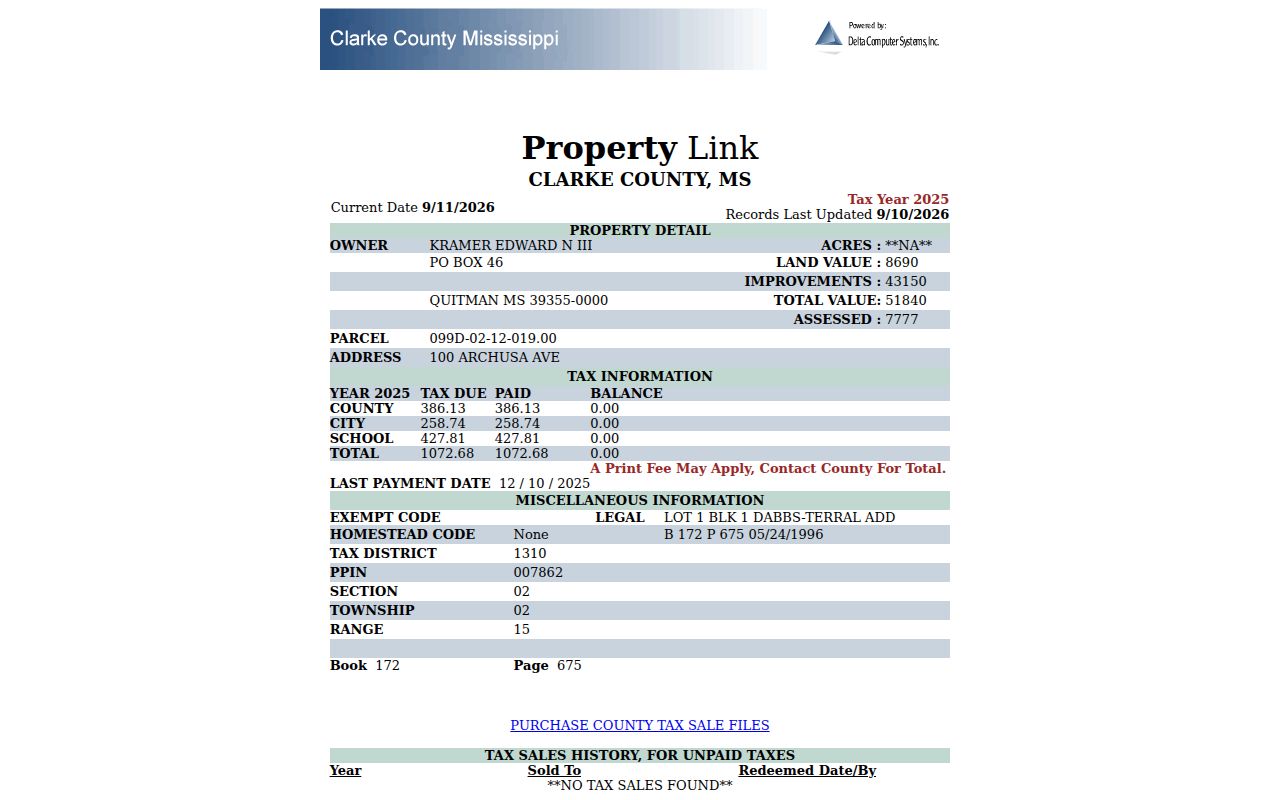
This image is one example, not a countywide rate statement. A print fee may apply. The county holds the total. A paid sample tells you nothing about a different parcel.
Note: Save the tax year and update date. Values, charges, exemptions, and balances change between rolls.
Search Clarke Property Tax Records
The Delta tax search takes one field at a time. Enter names last-name-first, or use Address Number and Address Street for known sites. Parcel Number and PPIN work as stronger exact keys, while Section, Township, and Range offer a rural-land route when no sound street address exists.
| Field | Best use | Verify |
|---|---|---|
| Name | Find bills tied to a displayed owner | Mailing and situs |
| Address | Known property site | Parcel and district |
| Parcel Number | Exact formatted key | PPIN and legal description |
| PPIN | Stable Delta cross-reference | Tax year and date |
| Section / Township / Range | Rural land | Owner and legal location |
Delta cautions that its uploads can lag behind courthouse changes. When a recent deed and the roll disagree, ask the Assessor which roll is displayed and rely on the recorded deed for transfer proof.
Look Up a Clarke Tax Bill
Keep both the parcel identity and the billing year. Start with an address when it is dependable, then switch to the PPIN or the exact APN. The Clarke Tax Assessor/Collector at 101 S Archusa Avenue, Quitman, can confirm a current account at 601-776-6931.
- Search Delta by address, parcel number, PPIN, or legal location and open the intended year.
- Verify owner, situs, APN, PPIN, district, and book/page before reading money fields.
- Read county, city, and school charges, paid amounts, last payment, and balance separately.
- Check exemption codes and tax-sale history, then call the Collector when a status is unclear.
- Assessed value
- The classified value used in the tax formula.
- Mill rate or levy
- The rate applied to assessed value.
- Homestead exemption
- Qualified relief claimed through the Assessor for a primary home.
- Tax lien
- A government claim linked to unpaid property tax.
Clarke Assessor and Collector Roles
The Clarke Tax Assessor/Collector performs linked but distinct work. Assessment locates, classifies, and values taxable property, maintains current ownership maps, and presents tax rolls to the Board of Supervisors. Collection bills and receives the tax. It also tracks payment or delinquency. A value question starts with assessment data, while a balance or receipt question starts with collection data.
Delta is the public online channel. The office counter, phone, and written request still matter when a card is behind, a print fee appears, or official confirmation is needed. State DOR guidance supplies the broad formula and appeal framework, but the locally adopted roll and the Clarke account status control the displayed bill.
Clarke Homestead Tax Relief
Mississippi's homestead filing window runs from January 1 through April 1. Applicants file with the Clarke Assessor for the physical home. DOR guidance identifies what to prepare: identity and eligibility information, the physical address, purchase and closing facts, vehicle tag numbers, and supporting papers.
The county forms page links a Homestead Exemption Worksheet. Use the current form and confirm any conditional papers with the office. The worksheet claims tax relief. It is not a deed and does not transfer land.
A blank or "None" code on one year's record describes that roll only. It does not decide later eligibility.
Clarke Tax Sales and Balances
Delta can display paid amounts, balance, last payment, and tax-sale history. The sample returned "NO TAX SALES FOUND." That applied only to that parcel and time. Search the correct year. Ask the Collector to confirm any current delinquency, redemption, or pending sale.
DuProcess adds recorded Tax Sale Release, lien, release, and deed categories. Clarke County Tribune legal notices offer another lead, since the weekly paper carries public notices. Reconcile the notice, the portal row, and current collector status. Property tax records alone do not settle title after a sale.
Note: A zero balance for one year does not prove that every prior tax year is clear. It also does not clear related recorded liens.
Contest a Clarke Assessment
Start by reading the parcel record itself. Compare the description, classification, land and improvement entries, and exemption status against what you know of the property. Then take any disagreement to the Assessor. Solid evidence makes the case. A survey, deed, photographs, or repair facts can all support an objection. Comparable sales or an appraisal can too. Ask staff when the roll opens for review. Ask also how to bring the matter before the Clarke County Board of Supervisors.
The Mississippi Department of Revenue outlines the state appeal process. Clarke County publishes no separate appeal form. No local deadline appears in its materials. Confirm each year's dates with assessment staff directly. Keep two matters apart: a question about a tax bill is not a value objection. Route the protest to the right office.
Confirm the appeal window. Ask the Clarke Assessor for the current roll-review and Board deadline before filing; no separate verified local form or date was found.
Historic Clarke Property Tax Records
Today's property tax records tell only part of the story. Mississippi Archives and History holds Clarke tax rolls reaching back to 1835. They run through 1892. The land rolls include 1883, 1887, 1889, and 1892. Other named years carry combined and personal-property runs.
A single roll can name the taxpayer. It can describe the land, and it states its value and tax for that year. A missing name is a clue, nothing more. A sale, a death, a move, a new exemption, a spelling change, or a lost volume could explain it. Check deeds and probate records before concluding that ownership changed hands.
Offline sources fill out the trail: the MDAH county catalog, the courthouse, FamilySearch, and library microfilm. Cite the roll number and year every time. Keep the category too, since a land roll and a personal-property roll answer different questions. Copy the column headings as well. A later reader can then tell acreage from value, tax, or a page reference.