
Compare Clarke County Property Value Types
Labels and custodians decide what a number can prove. In Clarke County, the assessor card and the Chancery deed index answer two different valuation questions.
| Value | What It Is | Where |
|---|---|---|
| Assessed value | The class-ratio value used for taxes | Delta assessor card |
| True or market value | The assessor's mass-appraisal estimate before ratio | Assessor and DOR rules |
| Recorded consideration | A transfer figure, not necessarily an open-market price | DuProcess deed detail |
| Land and improvements | Components that form the displayed total | Delta parcel card |
Mississippi assesses Class I owner-occupied homes at 10 percent of true value and Class II other real property at 15. Public utility property sits at 30 percent. The recorded class controls.
Read Clarke County's Four Value Numbers
PPIN 007862 makes a useful sample. Its card shows land at 8,690, improvements at 43,150, a 51,840 total, and a 7,777 assessed value, listed beside the owner, situs, and legal description. The official Delta parcel card adds the sketch.
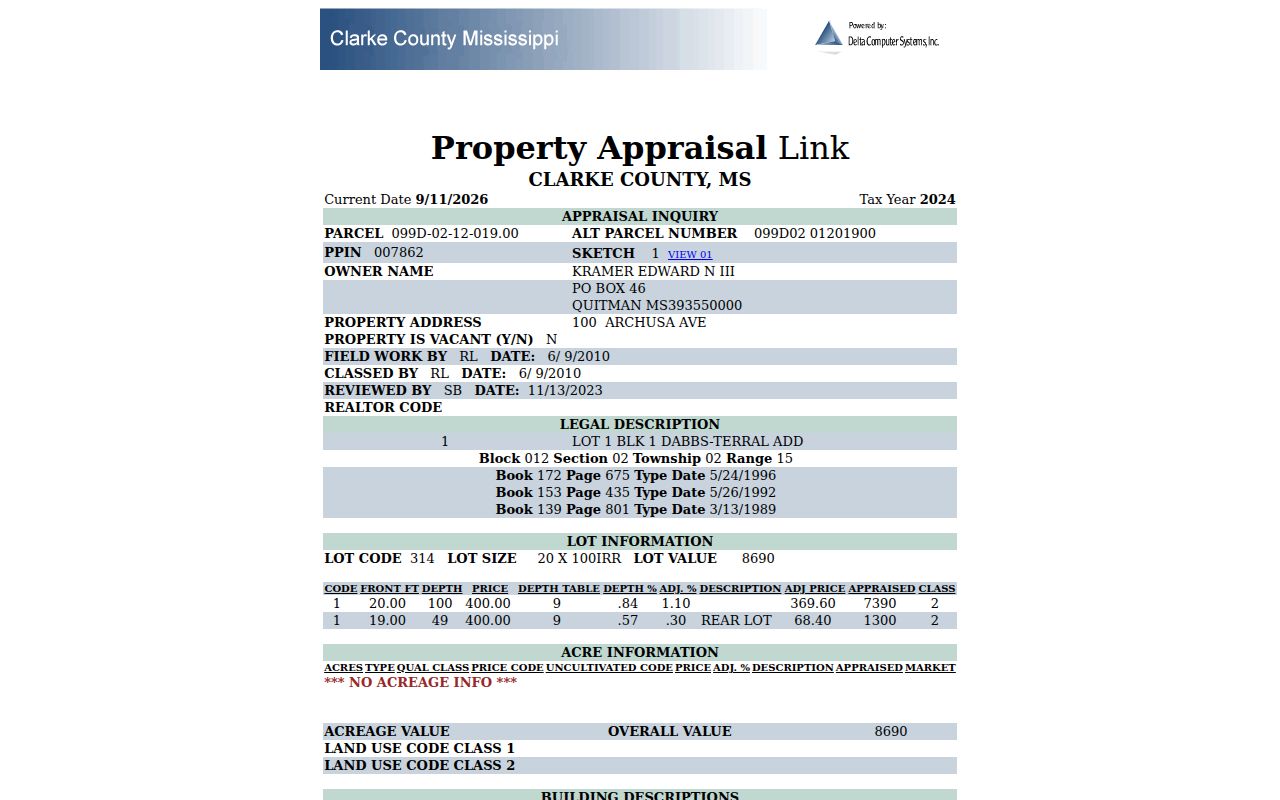
Each figure carries its PPIN and APN. That bond beats a loose value stripped of its parcel or year.
Apply Mississippi Ratios to Clarke County Value
True-value standards, classes, ratios, reappraisal, and millage are all laid out in the Mississippi Department of Revenue appraisal guidance. Know the class before reading assessed value. Residential-looking land does not always get Class I treatment, so never reverse-engineer market value from an unknown class. Homestead and exempt codes add tax context. They do not turn assessed value into an appraisal.
Add Clarke County Land and Improvements Carefully
Land and improvement fields are parts of the displayed total. They never show what a buyer paid. Nor do they price a replacement build. A sketch and legal description show what the card covers, though they certify no condition. When one component shifts, confirm the year and the parcel identity first. A split, new structure, removal, classification change, or routine reappraisal can all rewrite the record. Ask the assessor about any unexplained change. Avoid assigning a cause the card never states.
Estimate Clarke County Property Value From Records
Attach parcel, date, and value type to every figure.
- Search Delta appraisal records by address, parcel, PPIN, or owner.
- Verify PPIN, APN, situs, and legal description.
- Record land, improvements, total, assessed value, class, and year separately.
- Check the newest matching DuProcess deed for recorded consideration and its limits.
- Assessed value
- The value after the applicable class ratio.
- Market or true value
- The mass-appraisal estimate before ratio.
- Assessment ratio
- The class percentage applied to true value.
- Consideration
- A deed field that may not equal market price.
- Reappraisal
- A systematic value review, not a sale appraisal.
Compare Clarke County Deed Consideration
Consideration shows up in the DuProcess inquiry beside the grantor, grantee, filing date, book and page, parcel reference, and description. Confirm the instrument matches the land. Consideration may reflect a family transfer, an estate, a nominal sum, or multiple parcels. It is a recorded clue, not a licensed opinion.
Match a Clarke County Sale to the Same Land
Search by grantee or grantor, but remember a consideration figure is useful only after the parcel and legal description agree. Then compare PPIN, APN, subdivision, lot and block, Section/Township/Range, and any related instruments. One deed can cover several parcels. Single-parcel price inference is then unsafe. Read the deed type and capacity. An executor deed, quitclaim, life-estate instrument, or transfer between related parties may not reflect an arm's-length market sale. Do not force it into a universal sale-price field.
Date Clarke County's Assessed Value
Reappraisal can move true value. Classification, exemptions, or improvements move the assessed figure. Millage changes a tax bill without redefining any value field. Delta warns that uploads can lag courthouse changes, so if a recent sale, split, or correction is missing, ask the Tax Assessor/Collector which roll year and upload the card represents.
Use Clarke County Tax Rolls for Long Context
MDAH Series 1202 contains Clarke tax-roll material from 1835 through 1892. Those rolls show historic tax-listed names and amounts, but shifts in currency, assessment methods, land descriptions, and improvements defeat a simple dollar comparison.
Use the MDAH catalog, research room, or Quitman library microfilm access. Preserve the roll number and year, then pair the amount with deeds and plats.
Reach Clarke County Value Records Three Ways
Delta is the fast online route to appraisal and tax cards. The Tax Assessor/Collector can clarify a stale upload by phone. It can also explain a confusing field at the counter. A written request under the Mississippi Public Records Act can seek identifiable, non-exempt administrative records in a preferred format. It remains subject to reasonable procedures and fees. Deed consideration and certified instruments go through the Chancery Clerk. Use the DuProcess index and the courthouse copy channel. Nineteenth-century tax context lives at MDAH or on library microfilm. Whatever the channel, give the custodian the PPIN, APN, address, legal description, and year. That is what isolates the record.
Resolve a Clarke County Value Mismatch
Start by confirming both numbers refer to the same parcel and year. Next, label each figure as land, improvements, total true value, assessed value, consideration, or a tax amount. Then check the class ratio and any exemption code. Most conflicts are just fields with different meanings. When sources still disagree, note the page date and call the assessor. Delta uploads can lag courthouse changes, and a recent transfer may hit the deed index before the parcel card moves. Skip city-wide appreciation claims. None is established for Quitman, Stonewall, or Shubuta.
Distinguish Clarke County Mass Appraisal
Clarke County assesses every parcel through a mass appraisal built for tax administration. A licensed appraisal is different. It answers one question about one property, as of a set date. It draws on inspections, comparable sales, income, or cost evidence. The two figures can land near each other yet mean separate things. So match the number to the job at hand.
The assessor card also has firm limits. It cannot settle title, fix survey lines, reveal hidden defects, or catch unrecorded improvements. Treat the value field as a public record with one purpose. When a decision turns on facts outside that record, get the right specialist or instrument.
A short ledger keeps your numbers honest. Give it columns for source, parcel number, field label, amount, effective year, property class, and retrieval date. Deed consideration deserves its own row. Note whether a deed covers multiple parcels or a non-routine transfer. Keep land, improvements, total, and assessed figures apart instead of collapsing them into one number. A homestead code or exemption belongs in the ledger only as tax context. That discipline makes any comparison reproducible. It also stops a current assessment, an old consideration figure, and a paid tax amount from masquerading as the same kind of Clarke County property value.
Pull the assessor card again on your comparison date. Ask the assessor about any field that seems off. Never project a countywide or citywide trend from one sample parcel. The sample's recorded figures say nothing about a general appreciation rate. That rate cannot be assumed for Clarke County, Quitman, Stonewall, or Shubuta.
Keep Clarke County Value Apart From Tax Bills
A tax detail page can list county, city, and school charges, payment status, and any balance. Those amounts come from value, ratios, exemptions, and levies stacked together. So the bill is not a second estimate of worth.
For payment, homestead, tax sale, or contest procedures, see the Clarke County property tax records guide. Valuation meaning ends with the figure and its source.
Know What Clarke County Property Value Cannot Say
The assessor figure is mass appraisal for tax administration. It does not inspect every sale condition, defect, renovation, easement, or market shift. MARIS geometry is not a survey, and deed consideration does not certify present worth.
Value is not price. A Clarke County assessed value is not what the property will sell for and is not a licensed appraisal.